
If you’re a local business owner, marketer, or agency trying to stay visible in search in 2026, business listings are no longer a “nice-to-have” – they’re mission-critical. Many businesses are frustrated by dropping local rankings, inconsistent Maps visibility, or simply not appearing in AI-generated answers, even when their website is strong. That’s because modern search engines now rely heavily on structured listing data to determine trust, relevance, and proximity – and tools like Boostify 360 exist to help businesses stay accurate, active, and competitive without the constant manual work.
Business Listings in 2026: From Directories to Digital Proof
Here’s the thing – business listings used to be about citations and backlinks. In 2026, they’re about entity validation.
Google, Maps, and AI-driven search engines now treat your Google Business Profile (GBP) and supporting listings as a primary data source, not a secondary signal. If your listing data is incomplete, inconsistent, or inactive, AI systems struggle to trust you – regardless of how good your website content is.
This shift explains why many businesses are asking:
- Why did my local rankings drop even though my SEO improved?
- Why does my competitor show up in Maps and AI answers instead of me?
- Why does Google show outdated info about my business?
The answer almost always starts with listings.
How Business Listings Impact Rankings in 2026
The “Triple Constraint”: Proximity, Relevance, Prominence
Google’s local algorithm now weighs what many SEOs call the Triple Constraint:
- Proximity – How close the business is to the searcher
- Relevance – How well the listing matches the query
- Prominence – How trusted and popular the business appears
Your Google Business Profile directly influences all three.
Google Business Profile Is the Ranking Anchor
In 2026, optimized GBP signals account for roughly one-third of Local Pack ranking power. That includes:
- Correct primary and secondary categories
- Updated hours and attributes
- Keyword-aligned services
- Regular posts, photos, and updates
A neglected or outdated profile quietly loses ground – even if nothing “breaks.”
Consistency Is How AI Decides Who’s Legit
Name, Address, and Phone (NAP) consistency across platforms like Yelp, Apple Maps, Bing Places, and industry directories tells AI systems one thing: this business is real.
Inconsistent listings create doubt. And in AI search, doubt equals invisibility.
Behavioral Signals Now Feed Rankings
Listings are no longer passive. Google measures:
- Calls
- Direction requests
- Website clicks
- Photo engagement
These actions act as real-world proof that customers choose you-boosting both rankings and AI confidence.
Business Listings and Google Maps: Where Most Local Searches Start
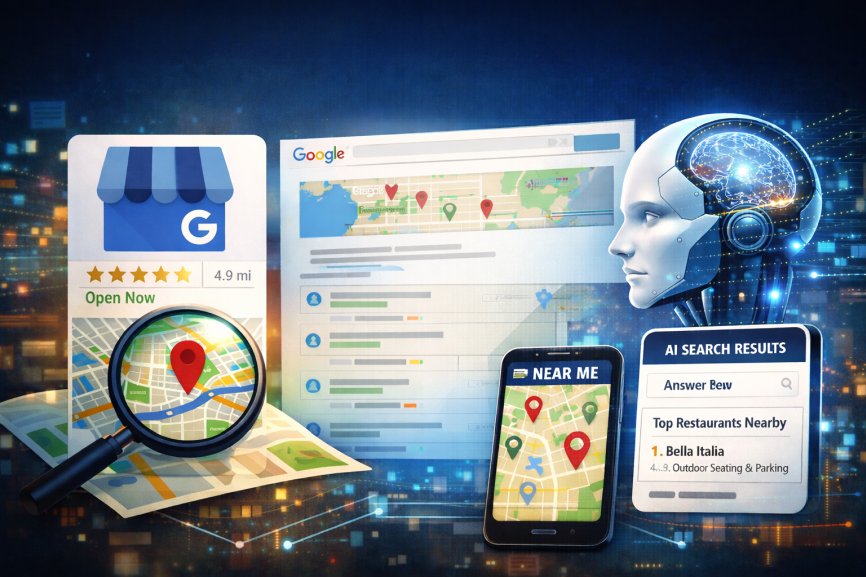
By 2026, over 90% of local searches display a Maps-first interface. That means your listing – not your homepage – is often the first impression.
Hyper-Local Competition Is Ruthless
Search results now change street by street. A business two blocks away with a more active listing can outrank you – even with fewer reviews.
Verified addresses, accurate service areas, and consistent updates are essential to win “near me” searches.
Static Profiles Don’t Compete Anymore
If your profile looks the same month after month, you’re falling behind. Google rewards:
- Weekly posts
- Fresh photos
- Seasonal updates
- Service highlights
This isn’t about gaming the system – it’s about showing signs of life.
“Ask Maps” Changed Discovery
AI inside Google Maps now answers questions like:
“Best Italian restaurant with outdoor seating and parking”
These answers come directly from listings, reviews, photos, and attributes – not websites.
Why Business Listings Power AI Search and AI Overviews
Listings Are the Data AI Trusts First
AI Overviews don’t “browse” websites like humans. They synthesize trusted data sources – and GBP is one of the most trusted.
If your listing is missing services, categories, or accurate details, AI simply skips you when generating answers.
Listings Build Entity Authority
Detailed, service-specific listings help AI understand:
- What you do
- Where you operate
- Who you serve
That’s how businesses earn Topical Authority inside AI knowledge graphs.
Reviews Are Now AI Training Data
AI doesn’t just count reviews – it reads them.
Sentiment, service mentions, and recency all matter. A steady stream of detailed reviews that mention real services dramatically increases AI-driven recommendations.
Key Actions Businesses Must Take in 2026
Optimize for “Near Me” Intent
Use hyper-specific categories and services (e.g., “emergency plumber” vs. “plumber”).
Treat Reviews as Structured Content
Respond to every review. AI-assisted replies help reinforce keywords naturally while increasing engagement.
Earn “Best Of” Mentions
Expert-curated lists are now a major AI trust signal – far beyond traditional backlinks.
Use Photos and Videos Strategically
Visual content helps AI verify authenticity, location, and relevance. Real photos beat stock images every time.
Where Most Businesses Struggle (and How to Fix It)
Let’s be real – keeping listings optimized across platforms is time-consuming, easy to forget, and surprisingly technical.
That’s why many businesses lean on platforms like Boostify 360, which automate listing activity, surface inconsistencies, and provide clear audits so nothing slips through the cracks. It removes the guesswork while keeping your listings aligned with how search actually works in 2026.
The Bottom Line: Listings Decide Visibility in 2026
In today’s search landscape, business listings aren’t just supporting SEO – they are SEO.
They influence rankings, Maps visibility, and whether AI engines choose you as the trusted answer. A well-maintained listing can outperform a stronger website, while a neglected one can quietly erase your visibility.
In 2026, the businesses that win aren’t louder – they’re clearer, more consistent, and easier for AI to trust.